Sunday, November 14, 2021

Make Hindi the Language of the Supreme Court and Other High Courts

One will have to admire the honesty of the Chief Justice of India for his confession of being a non-sophisticated speaker in the English language. In fact, what he has said about himself is truer about most of the lawyers and judges of the country. Only a minuscule minority having had the privilege of getting an education from the top schools can boast of fairly good command over the English language.  Regrettably, those lawyers who possess proficiency in the English language, get undue importance in the Supreme Court even by those judges, who have had their schoolings through their mother tongues.

Most of us have started learning English as one of the subjects when we were admitted to the sixth standard. Most of the students in village schools used to bid farewell to the English after somehow passing the eighth standard. In most Law Colleges the medium of instruction is either Hindi or regional languages. There is nothing wrong with it, rather it should be appreciated that our dependence on the English has vanished in state sooner than later.

For those who come to practice in the Supreme Court, their comprehension of the English language is no better, although they will demonstrate their vociferous opposition to the Hindi language for no genuine rhyme and reason. I have seen a High Court judge practising in the Supreme Court after his retirement and speaking like, ‘he did not went’ instead of ‘he did not go’. I can say with all the emphasis at my command that those coming from non-Hindi speaking areas can master Hindi with even one-fourth of the effort that they put into learning half-baked English.

In this regard, some constitutional changes are required to be made. Article 348 speaks of only English to be the language of the Supreme Court and the High Courts. However, 348(2) of the Constitution provides that (2) Notwithstanding anything in sub-clause (a) of clause (1), the Governor 1 *** of a State may, with the previous consent of the President, authorise the use of the Hindi language, or any other language used for any official purposes of the State, in proceedings in the High Court having its principal seat in that State: Provided that nothing in this clause shall apply to any judgment, decree or order passed or made by such High Court.

Taking advantage of this proviso in many of the states Hindi has been made the language of their High Courts. But for bringing about the desired change in the Supreme Court, it is the Parliament of India, which has to step in. Even otherwise also, English was to be used as the language of communication, as per Article 346, with the non-Hindi speaking state only for 15 years and that period was over long back.

This is the time that when a predominantly large number of Parliamentarians and judges are Hindi speakers, the Hindi should be given the pride of place in all spheres. During the last seventy-five years, Hindi has obtained acceptability, not only in the country but in many countries across the world. Prime Minister Modi, who is an enviable speaker in Hindi, can help make Hindi the official Lingua Franca of the country. His government has already given importance to Hindi and other languages for imparting education in the New Education Policy. We hope that the English would be replaced in the Supreme Court and other High Courts under Modi’s leadership. He will be remembered by the posterity for this revolutionary step as it will provide freshness to arguments, judgments and jurisprudence in the Supreme Court and the High Courts.


Monday, November 1, 2021

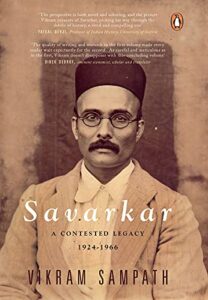
Absorbing and Compelling Biography of Savarkar


Parmanand Pandey

There are some path-breaking books that open the eyes of the readers. The two-volume biography of Vinayak Damodar Savarkar by Vikram Sampath is certainly one of them. The first volume titled ‘Savarkar: Echoes from a Forgotten Past’ covered his life from 1883 to 2023. It was published in 2019 and talks about his daring escape and capture from the ship S. S. Morea at Marseilles (France) and the long and harrowing incarceration in the Cellular Jail of Andaman, more known as Kaala Paani. The second part is the sequel of the first one, which is named’Savarkar: A Contested Legacy’ and covers his life from 1923 till his death in 1966. It deals with his activities of social reforms, political activities from the platform of Hindu Mahasabha, elucidation of the concept of the Hindutva, opposition to the idea of Gandhi’s non-violence and the two-nation theory of MA Jinnah. The book provides a vivid description of the red fort trial of Mahatma Gandhi’s assassination case.
Savarkar worked vigorously for the eradication of the caste system, particularly the abolition of untouchability, from the Hindu society. He advocated for the reconversion of Muslims and Christians to Hinduism, who had abandoned their religion because of force, fraud, and other inducements. He was deeply pained to see the farcical Hindu Muslim unity that was being trumpeted by Mahatma Gandhi by supporting the Khilafat movement. Instead, he told Muslim brethren that ‘you are Hindu by blood and race, and you are dearer to us than the Muslims of the world, but if you feel that you are dearer to the Islamic countries like Turkey than the ‘Hindu Kafirs’, then do understand that this delusion will end in your downfall.’ For him, in fact, ‘Hindu-Muslim unity was a mirage and ‘Hindutva’ is the only nationalist creed.’
Savarkar had talked about seven shackles of Hindu society. They were (1) denial of Vedic literature to one and all Hindus; (2) choice of profession by merit, not heredity; (3) untouchability; (4) barring crossing the seas fearing loss of caste;(5) denial of reconversions to Hinduism; (6) restrictions on inter-caste dining; and (7) inter-caste marriages. Thankfully, most of these shackles have either now got broken or diluted with the passage of time but the curse of casteism and non-entry of other religions to Hinduism is not only continuing but has become more entrenched. He sharply disagreed with Mahatma Gandhi, who was of the view that Islam was the religion of peace. Savarkar was candid and direct in asking him: what makes you think so patently wrong? He was of the view that Buddhism, Christianity and Hinduism, of course, teach peace but not Islam.
Savarkar was always ready to work with the Shuddhi movement of Arya Samaj and with its help in October 1926 he converted one Professor Pinto of Lucknow to Hindu fold. Professor Pinto was M A from Cambridge and was attracted to Hinduism after having studied comparative religion. There is an interesting incident that happened in January 1928, Tukoji Holkar, Maharaja of Indore, wanted to marry an American girl, Miss Miller but it was being opposed by orthodox Hindus. He was even ready to convert to Islam to marry the girl he was madly in love with. Savarkar supported him to marry his ladylove without converting to Islam. He got support from the Arya Samaj and even from the Shankaracharya. Maharaja was so happy with Savarkar and Shankaracharya that he gave a generous grant of Rs Two lakhs for undertaking Shuddhi work.
The amount of work that has been done by the author in writing the biography is really mind-boggling. One is amazed by the industry, inclination and commitment to the cause of presenting the authentic life history of Savarkar. There is no trace of hagiography, which is usually found in the biographies. The readers have been left to arrive at their own conclusions on the basis of the copious facts. Savarkar analysed the problems of Muslims that ‘their theology and politics divide the human world into two groups only- The Muslim land and the enemy land. All lands which are either entirely inhabited by the Muslims or ruled over by Muslims are Muslim lands. All lands, which are mostly inhabited by non-Muslim power are enemy lands and no faithful Muslim is allowed to bear any loyalty to them and is called upon to do everything in his power by policy or force or fraud to convert the non-Muslim there to the Muslim faith, to bring about its political conquest by a Muslim power. Consequently, traditional patriotism is a word unknown to the Muslim-nay is, taboo, unless in connection with a Muslim territory…………… They could not be accused from their point of view of being traitors to Hindustan. Their conscience was clear. They never looked upon today’s Hindustan as their country. It is to them already an alien land, and enemy land- ‘a Dar ul Harb’ and not a Dar-ul- Islam’.

Savarkar shared the views of Dr BR Ambedkar, who while quoting Theodore Morrison speech delivered in Paris in 1899, had said, ‘The views held by the Mohammedans are alone sufficient to prevent the establishment of an independent Indian Government. Were the Afghan, to descend from the North upon an autonomous India, the Mohamedans, instead of uniting with Sikhs and the Hindus to repel him, would be drawn by all the ties of Kinship and religion to join his flag.’ Dr Ambedkar further said that ‘Hinduism is said to divide people and is in contrast Islam is said to bind people together. This is only a half-truth. For Islam divides as inexorably as it binds. Islam is a close corporation and the distinction that it makes between, and non-Muslims is a very real, very positive and very alienating distinction. The brotherhood of Islam is not the universal brotherhood of man. It is the brotherhood of Muslims for Muslims only. To the Muslims ‘ibi bene ibi patria (where there is bread, there is my country) is unthinkable. Where there is the rule of Islam, there is his own country. In other words, Islam can never allow a true Muslim to adopt India as his motherland and regard a Hindu as his kith and kin. That is probably the reason that why Maulana Mohammed Ali, a great Indian but true Muslim, preferred to be buried in Jerusalem rather than in India.’

A life full of miseries

Savarkar’s life was full of miseries from his young days to the last breath of his life. It is difficult to fathom the pains that he endured in his lifetime but never deviated from his chosen path. The famous Amrit Bazar Patrika wrote about
him saying ‘whether one agrees with all his views or not, Mr Savarkar compels attention by his boldness and clarity of his utterances. He knows no doubt or hesitation. His logic is merciless, his humour caustic, and his irony effective. He is a man with a mission.’
Savarkar had never made any bones of his disliking for the policies, principles, and programmes of Mahatma Gandhi. Non-violence for him was not only sinful but immoral as well. He used to say that the doctrine of no-violence numbed the revolutionary fervour, softened the limbs and hearts of Hindus, and stiffened the bones of enemies. The lambs resolved to lead vegetarian life, but wolves were not connected with their pious resolution. It may sound strange, but it is a fact that Savarkar was an ardent supporter of Cow protection but was against Cow worship. This was the reason that his name was even being linked with the murder of Mahatma Gandhi although he was exonerated of all charges in the Red Fort trial. Nonetheless, his adversaries always try to paint him as the guilty man of Mahatma Gandhi’s murder. He himself had claimed that he was neither a fanatic Hindu nor a communalist but ‘I cannot make donkeys think like horses.’ He was a staunch supporter of Hindi in Devanagari script for making it the national language.
In the twilight of his life, he was almost immovable and had abandoned taking anything before proceeding for his last journey. He remained engulfed with controversies during his lifetime as well as after his death. Glowing tributes were paid to him after his death by the political leaders of all hues.
The book is a commendable effort to make the objective assessment of Veer Savarkar and deserves to be read by all those interested in the history of the freedom struggle. It is written in a racy style and good English and keeps the readers absorbed from beginning to the end.

Sunday, October 24, 2021

Goal of 50 %Women Judges is a Mere Will-o-Wisp

Goal of 50 %Women Judges is a Mere Will-o-Wisp
Hon’ble Chief Justice of India NV Ramna, the other day, while inaugurating a meet of the women advocates and judges in the Supreme Court gave a very call that they must unite and scream for 50 per cent reservation in the judiciary. Paraphrasing Karl Marx, he said that ‘women of the world unite as they have nothing to lose but their chains. It is nothing but romanticizing of the women’s struggle. It cannot be said to be a reasonable and judicious call by any yardstick. Women cannot be compared with workers of any industrial house, who can be exhorted for class struggle. Women come from a different socio-economic milieu like their men counterparts, they cannot be expected to come on the roads and fight for 50 per cent reservation.
The Hon’ble Chief Justice furnished some startling data like out of 17 lakh lawyers across the country, only 15 per cent are women. The number of judges in the subordinate judiciary is about 30 per cent, in the High Courts and the Supreme Court, it is slightly more than 11 per cent.
Now the question that arises here is that if there are only 15 per cent women in lawyering, how can it be made 50 per cent in the appointment of judges across the board? Can the country afford to have second-rate judges and spoil the standard of justice in its zeal to achieve the objective of 50 per cent judges? The reply is an emphatic NO.
As a matter of fact, we have to create an atmosphere, which should attract a large number of women towards the legal profession, nay to all professions. The standard of education has to be elevated; facilities need to be upgraded. The conducive environment and proper facilities are to be developed to attract more women to the judiciary or for that matter any other profession. There is no doubt that quite a substantial number of women are doing extremely well in the profession. Many of them do not want to go to the judicial services because of multiple obstacles and compulsions. Some of them are related to their families and they need to be addressed with the active cooperation of the Bar, Judiciary, Government, and above all the society.
So long, it is not done, it will be like a wild goose chase. Neither the quality of justice will be improved nor the desired goal of increasing the number of judges will be achieved.

Demand of Caste Census is Preposterous: Firmly Reject it


These days the demand for caste census is being raised particularly in Bihar and Uttar Pradesh, where the politics usually revolves around castes. The irony is that it is being demanded by those, who claim to be the votary of the casteless society. There is ample testimony that the socialists, led by Dr Ram Manohar Lohia, have been the real progenitor of caste politics in the country. Instead of making any positive efforts for the establishment of the casteless society, they almost spent their whole energy in perpetuating this social evil.
The Congress Party did not lag behind in exploiting caste politics to remain in power for long years. In fact, it not only encouraged casteism but also made all efforts to appease the minorities so as to remain ensconced in power. Some political leaders think that it will provide them with the opportunity to make further demands for reservations in government jobs and educational institutions on the basis of the castes. This demand has become more intense and vigorous particularly after the decision of the Modi government to provide ten per cent reservation to the weaker section among high caste Hindus.
This idea of caste census is fraught with innumerable dangers for the unity of the country as it will pour oil on the fire being smouldered by fissiparous elements, which are presently dormant for many reasons but mainly due to the strong government at the Centre. Assuming that the proposal for caste census is accepted then what will be its fallout? Will it stop at that? No, never.
If the caste census is done, then the caste leaders will again ask that the reservation should be done as per the proportion of the population of the particular caste. For example, the Yadav will say that since their number is more than Kurmi or Kushwaha in Uttar Pradesh and Bihar, therefore, they must get more reservations than others. This will ultimately lead to the caste war in different parts of the country. Once the caste war has started civil war will not be far away. It will be difficult for any government to handle it, giving the opportunity of rejoicing to the enemies of the country, who will do everything to fan it.
This also demonstrates how myopic our leaders are, who do not believe in the universal progress of all groups of society. They want to further drive a wedge among different castes causing a hugely deleterious impact on our cohesive social fabric. Therefore, the government must reject this dangerous demand with all firmness that it possesses.

Saturday, September 25, 2021

Only Increased Use of Technology can Prevent Rohini Court Type of Crimes

Parmanand Pandey The gruesome shootout at Rohini court yesterday was shocking, without doubt, but not surprising. It has not happened for the first time, such incidents have occurred many times in many countries, but the moot question is that despite the incredible march of technology, why is it not being used to prevent such incidents? Why, at all, the dreaded criminals and gangsters are brought to the courtrooms causing huge inconvenience to the public? The governments have to incur a lot of expenses in transporting the hardened criminals from jails to courtrooms and back to their cells. Nowadays, video conferencing can be very easily done. The increased use of Artificial Intelligence (AI) can reduce the number of cases by at least 70 per cent. A large number of flimsy and frivolous cases are filed every day, and they can be filtered by AI. This will save the expenses of the government and the public from unnecessary botheration. The number of courtrooms and judges will be considerably reduced. The courtrooms, which will become surplus, can be used for some other purposes. The second thing that can be done is to change the mindset of the judges and the advocates. Why should they not be properly screened and frisked before entering the court premises? It is often seen advocates quarrelling with the security staff. They flaunt and throw around their weight of being in the robes. This must be done away with, and everyone must be subjected to strict checking. For this purpose, high-quality sensory machines can be installed, which can very easily detect the arms that might be carried under the coats and gowns of the lawyers. The need is to get the solution to the problem and not to go on strike at the drop of the hat. The live streaming of the courtroom proceedings is long overdue. But why this is not being done in the right spirit beggars all logic. Live streaming will certainly remove the lethargy of the judges and the advocates. The Bar Council and the Bar Associations must play a pivotal role in overhauling the court proceedings. Cosmetic changes here and there will be of no use. The days are over when the third-rate judicial system silently suffered. The new generation is fed up with the sleepy judges, cunning lawyers and go-getting touts.

Tuesday, September 14, 2021

SC gets tough for not appearing in proper dress

Hearing of cases in courts in Virtual mode is a blessing, particularly for the senior advocates, because they can manage their cases from the cosy comforts of their houses or offices. However, sometimes, they also get a snub from the courts for not adhering to the dress code or for not following the basic protocols of the courts. Some of the advocates have even been seen sipping tea while arguing their cases, which is unthinkable in the physical mode. This happened today with Senior Counsel KTS Tulsi, who, by the way, is also a Member of Parliament (Rajya Sabha) got a snub by the bench of Justice Vineet Saran and Justice Aniruddha Bose. As far as the dress code is concerned, it is an altogether different issue and Shri Tulsi being a lawmaker and interpreter of the law can definitely take a stand to get it changed.

When Shri Tulsi appeared today in Virtual Court number 9 of the SC without wearing a neckband and a black coat, Justice Saran asked him: Are you appearing as an Advocate? If you are appearing as an Advocate, why are you not in the proper dress? Profusely apologising to the Court, Shri Tulsi, sought a minute's time from the court to wear the coat and band. In the meantime, the court took up the next matter, which did not take more than two minutes. By that time Shri Tulsi was ready in the proper dress to argue the case.
Hearings in virtual modes have received mixed reactions from the Bench and the Bar as well. It is, without doubt, a time-saving, money-saving, and pollution protecting mode. On average, an advocate has to waste nearly two hours of time commuting from home to the court and back from the court to the home, if the court works in physical mode. The money spent on conveyance and petrol fuel is also saved in virtual modes and in the process, the congestion on the roads and atmospheric pollution is reduced.
It has many demerits also. For example, it does not give the feel of the courts. One can only see either the Bench or one or two more advocates because the audio and video of advocates are kept disabled by the host. One cannot have the benefit of hearing the arguments of other advocates in the absence of enabling links. Our Bars are bereft of innovative ideas, so nothing better be expected from them.
This can certainly be adequately addressed if the live streaming of all courts is started. Live streaming will be immensely helpful in making the judges and lawyers more responsible. At present, it is found that in most of the courts, judges sit and leave the courtrooms as their whims and fancies. The Supreme Court is, of course, an exception, where the judges are mostly very punctual. The virtual mode has deprived the opportunity of socialisation among advocates and clients. Thrills of gossips in the canteens and the search for relevant materials in the libraries are felt like pangs.
The other difficulty relates to technology because, in many places, the internet is found to be very erratic. If teething troubles are got over, the technology can give optimum benefits. The proper use of Artificial Intelligence (AI) will not only reduce the burden of the courts but will also go a long way in filtering the frivolous cases, which consume a lot of judicial time of the courts.

Wednesday, September 1, 2021

 Laudable Supertech Judgement

Parmanand Pandey

 The judgment of the Supreme Court in the Supertech case of NOIDA will be long remembered and it must be strictly executed. The judgment has sent a highly positive message across the country that ‘high and mighty'  cannot take the law into their own hands. Unfortunately, this perception has gained momentum, particularly after the Union Carbide case that powerful persons have very safe escape routes, and the law cannot touch them. This is the reason that they flout the rules and the laws with gay abandon. The stinging comment of the Supreme Court on the corruption of officials must wake up the higher authorities to take stringent action against those, who allowed the Supertech to go like an untamed and unfettered bull. To mete out exemplary punishment to those reeking with corruption from their noses, eyes, and ears will serve the ends of complete justice.

 The justice, as they say, must be reformative and deterrent. In a democratic society like ours, retributive justice has no place. Of late. The cynicism has also grown among people about the judiciary. The conduct of the shady judges has been largely responsible for the unsavoury image of the judiciary. That is why, it is said that judges should be like Caesar’s wife, beyond any reproach.

  There is not even a shred of doubt that without the complicity of the officials, it is not possible to get any illegal construction done. Large-scale illegal constructions in any city bear the testimony of the huge corruption among officials. Almost all illegal constructions in Delhi scream about the neck-deep corruption prevailing in the DDA. Corrupt officials enjoy the full support of corrupt politicians for mutual benefits. The unplanned growth in Delhi could not have been possible without the complicity of the DDA, MCD and the Police. If exemplary punishments were given to them, Delhi would have been the ideal place.

To uphold the majesty of justice, it is all the more necessary to take action against NOIDA officials, and only then the maxim that ‘howsoever high one may be, the law is above them’ will have dignity and grace. Among all three organs of the State- the Legislature, the Executive, and the Judiciary, it is the judiciary that enjoys the highest respect and trust of the people. The Legislature and the Executive have lost much of their sheen.

It is, therefore, the responsibility of the Judiciary is to ensure that the powerful persons are not allowed to hold the common people to ransom as per their whims and fancies. This decision of the Supreme Court will, without doubt, instil a new sense of confidence in the public.